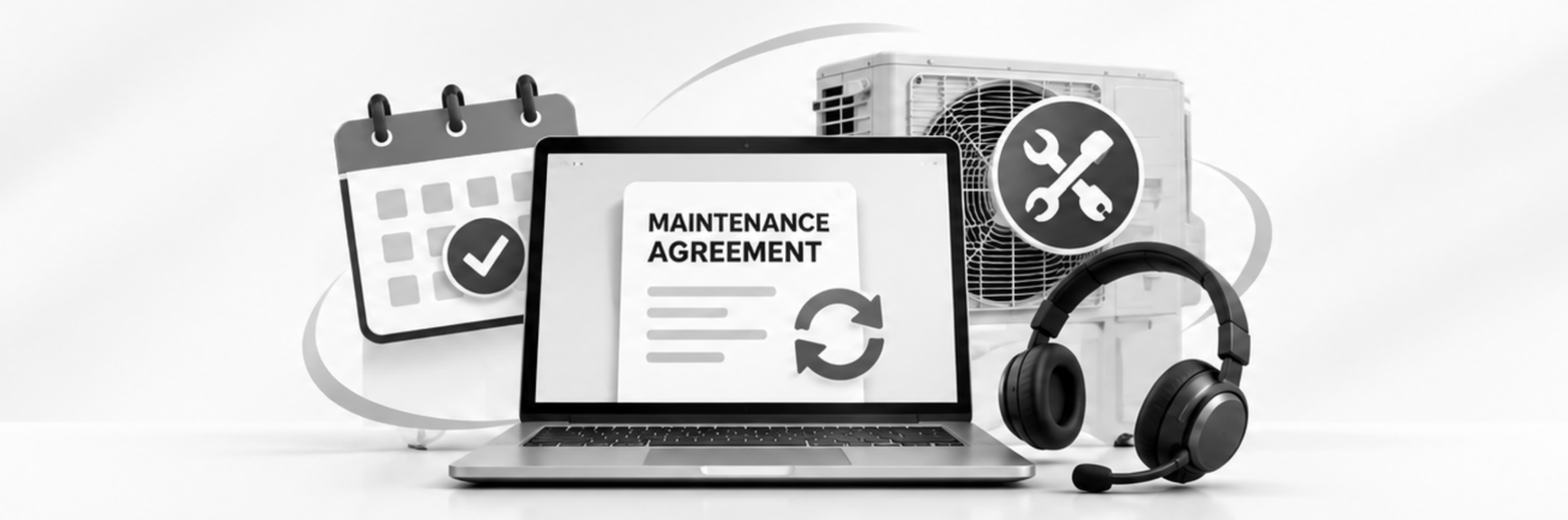
A maintenance agreement brings a customer back for scheduled visits, such as a furnace check in the fall and an air conditioning check in the spring. The CDC recommends having heating systems serviced every year as one way to prevent carbon monoxide poisoning (CDC, Carbon Monoxide Fact Sheet).
Renewing those agreements is mostly office work done by phone, email, and software. That makes it work that someone outside the office can handle, much like estimate follow-up.
A remote team member usually needs access to customer records, agreement terms, the schedule, and the notes field in the company’s field service software. Where the software allows it, the owner can limit which parts of the account each user can see and change.
Payment details can be entered directly into the payment processor or software, which keeps them out of notes and emails. A written renewal script covers what the agreement includes, the price, the renewal date, and how the customer can cancel.
Some states regulate agreements that renew automatically. California has one of these laws, the Automatic Renewal Law (California Business and Professions Code, Article 9). Under the current version of the law:
The latest amendments apply to contracts entered into, amended, or extended on or after July 1, 2025. Companies selling automatically renewing agreements to California customers can check how the law applies to their plans, and companies in other states can check whether their state has a similar law.
At the federal level, the FTC asked for public comment in March 2026 on whether to update its Negative Option Rule, which addresses offers that renew or continue unless the customer cancels (FTC, March 2026).
A remote team can track these dates the same way it tracks expiration dates, as part of a renewal calendar.
California’s law also covers phone cancellations. A business that offers cancellation by toll-free number answers those calls promptly during business hours. If a customer leaves a voicemail asking to cancel, the business processes the cancellation or calls the customer back within one business day (California Business and Professions Code, Article 9).
The law allows a business to offer a discount or explain what the customer loses by cancelling, as long as it first tells the customer they can complete the cancellation at any time by saying they want to cancel. Once the customer says so, the cancellation is processed.
A renewal script can include this wording so every caller hears it the same way, along with where to record the reason for cancelling.
When a customer renews, booking the first visit of the new term on the same call puts it on the calendar before the call ends. Heating checks are usually scheduled before cold weather and cooling checks before hot weather, so renewals that come due in late summer and late winter can be timed around those visits.
Reminders before each visit help keep it on the schedule, as covered in Fewer No-Shows Start With a Better Scheduling Routine.
A short monthly report shows how many agreements came due, how many renewed, how many cancelled, and why. The reasons customers give for cancelling can point to changes in pricing, visit timing, or what the agreement includes.
Avidus teams handle back office work for repair and maintenance companies, including follow-up calls and scheduling. Each client’s tasks are mapped into a written process before the team goes live, and that process is reviewed with the client as the business changes. To compare the cost of handling renewals in-house with handing them off, the Avidus ROI calculator shows the monthly cost of the work you choose and a plan for passing it on.