Customers who call about a new air conditioner or heat pump sometimes ask about the refrigerant. Some have read that R-410A is being phased out. Others see an unfamiliar refrigerant name on a quote, or have heard that the rules changed again this year.
The rules come from the U.S. Environmental Protection Agency (EPA), which has revised them several times since 2023. The most recent change was finalized in May 2026. Office staff can answer most of these questions with a few facts and pass the rest to a technician.
EPA’s Technology Transitions program limits the refrigerants allowed in new residential and light commercial air conditioning and heat pump systems. Since January 1, 2025, new systems in this group have had to use a refrigerant under EPA’s global warming potential (GWP) limit of 700 (EPA, HFC Restrictions by Sector).
GWP measures how much a gas adds to warming compared with the same weight of carbon dioxide. A gas with a GWP of 700 has 700 times the effect of carbon dioxide (EPA, Frequent Questions on the Phasedown of HFCs).
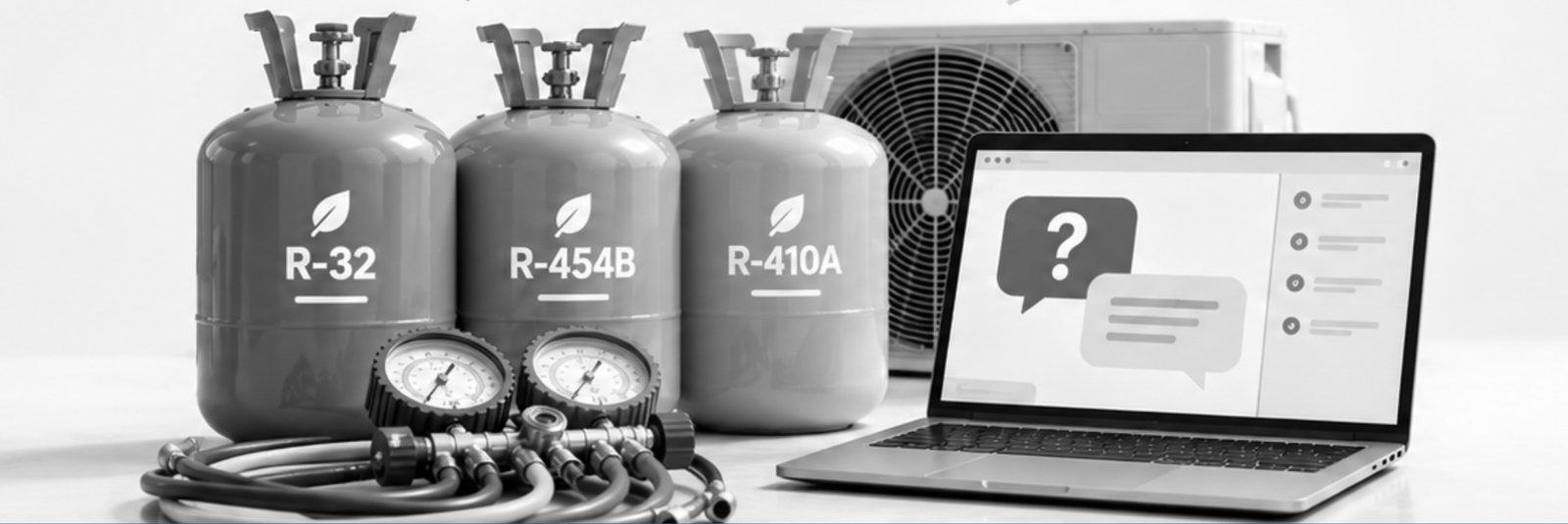
R-410A has a GWP of 2,090, which is above the limit. EPA lists several replacements as acceptable for new equipment in this category, including R-454B, with a GWP of 470, and R-32, which EPA lists as HFC-32, with a GWP of 675 (EPA, Substitutes in Residential and Light Commercial Air Conditioning and Heat Pumps).
The refrigerant a system uses is printed on its nameplate. On a central air conditioner, the nameplate is usually on the outdoor unit (EPA, Homeowners and Consumers FAQ). A caller who isn’t sure which refrigerant they have can be asked to read it from there.
EPA had set January 1, 2026 as the last day to install new R-410A systems built from inventory made before 2025. In May 2026, EPA finalized a rule that removed that date. Systems whose components were manufactured or imported into the United States before January 1, 2025 can now be installed until that supply runs out (EPA, Technology Transitions Reconsideration Rule Fact Sheet).
New systems built from components made on or after January 1, 2025 still need a refrigerant under the 700 limit (EPA, HFC Restrictions by Sector).
Information published before May 2026 may still list January 1, 2026 as a deadline. A customer who has read it may ask whether an R-410A quote is still allowed. If the equipment comes from pre-2025 inventory, it can be installed under the current rule.
EPA’s rules apply to new equipment. Owners can keep using an existing system and have it repaired for the rest of its working life. That includes replacing a major part, such as the condensing unit or compressor (EPA, Frequent Questions on the Phasedown of HFCs).
Parts made for R-410A systems after January 1, 2025 carry a label reading “for servicing existing equipment only” (EPA, Frequent Questions on the Phasedown of HFCs).
EPA counts it as a new system when the condensing unit and the indoor coil are replaced together, even if the refrigerant lines stay in place. Replacing one of them now and the other later is treated as a repair (EPA, Frequent Questions on the Phasedown of HFCs).
R-410A is a hydrofluorocarbon (HFC) blend. Under the American Innovation and Manufacturing (AIM) Act, EPA is lowering the amount of HFCs that can be produced or imported in the United States in steps. The cap is 60% of the historic baseline from 2024 through 2028, 30% from 2029 through 2033, 20% in 2034 and 2035, and 15% from 2036 onward (EPA, Frequent Questions on the Phasedown of HFCs).
EPA notes that HFCs and replacement parts may become harder to find over time as the phasedown continues (EPA, Frequent Questions on the Phasedown of HFCs). Questions about what this means for a specific repair, or about future prices, are best answered by a technician or the owner.
R-454B and R-32 are classed as A2L refrigerants, and R-410A is classed as A1 (EPA, Substitutes in Residential and Light Commercial Air Conditioning and Heat Pumps). These safety classes come from ASHRAE Standard 34, where the 2L class covers refrigerants with lower flammability (ASHRAE, Addendum g to Standard 34-2016).
EPA lists the A2L refrigerants as acceptable in new residential and light commercial equipment, subject to use conditions set out in its rules (EPA, Substitutes in Residential and Light Commercial Air Conditioning and Heat Pumps).
A customer who asks whether a particular installation is safe for their home can be offered a call or visit from a technician, who can explain how the equipment is designed and installed.
Some callers have older systems that use R-22, also called HCFC-22. Production of new R-22 ended in 2020. Owners can keep using these systems, and reclaimed R-22, along with R-22 made before 2020, is used to service them. EPA rules also allow an owner to replace a broken condensing unit on an R-22 system (EPA, Homeowners and Consumers FAQ).
The AIM Act allows states to set their own HFC restrictions in addition to EPA’s. Where a state has done so, both sets of rules apply. EPA lists twelve states with laws or regulations of this kind: California, Colorado, Delaware, Maine, Maryland, Massachusetts, New Jersey, New York, Rhode Island, Virginia, Vermont, and Washington (EPA, Frequent Questions on the Phasedown of HFCs).
Companies working in those states can check the state rules before answering installation questions.
Office staff can share the general rules. Questions about a specific system are usually better answered by a technician. These include whether to repair or replace, whether a part is available, and what a job will cost.
Work on the refrigerant itself, such as adding or removing it, is done by a technician certified under Section 608 of the Clean Air Act (EPA, Section 608 Technician Certification Requirements).
Noting the caller’s question in the job record before the callback lets the technician answer it without asking again.
When more than one person answers the phone, a short written script keeps answers the same from one call to the next. A script for refrigerant questions can cover the current EPA rules, the questions that go to a technician, and where to note a callback request.
These rules have changed several times since 2023, so it helps to name one person who updates the script when EPA publishes a change. EPA keeps a contact list for Technology Transitions updates, which can be joined from its regulatory actions page.
Avidus maps each client’s calls into a written process before its team goes live, then reviews that process with the client as the business changes. To compare the cost of handling calls in-house with handing them off, the Avidus ROI calculator shows the monthly cost of the work you choose and a plan for passing it on.