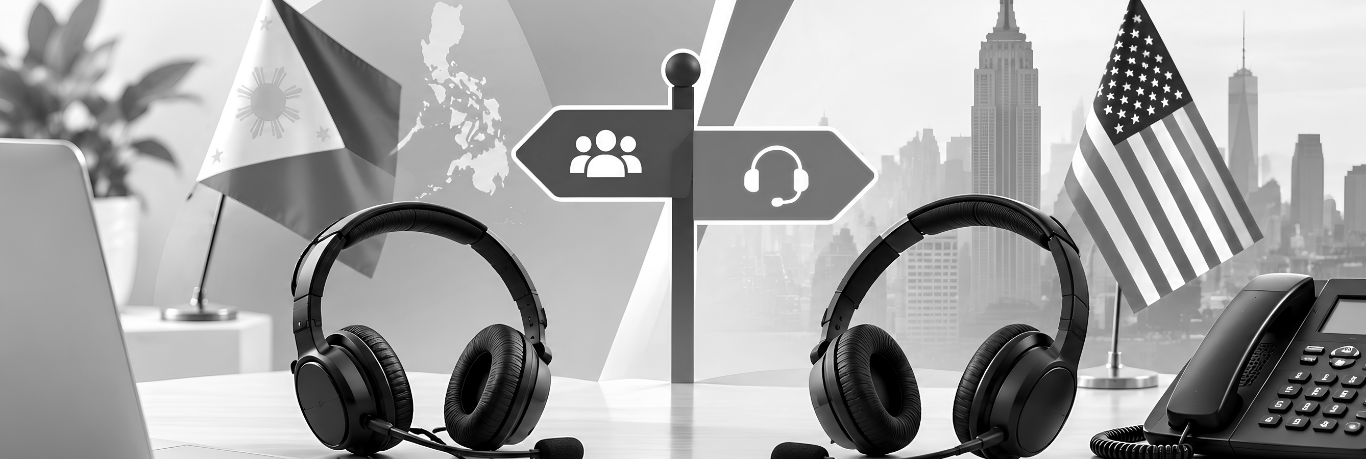
Most repair contractors and property managers looking at phone coverage end up with two shortlists. One has domestic answering services on it. The other has offshore providers, most of them based in the Philippines.
The two are often priced and pitched as the same product, and they are not quite. They differ in how staff are assigned, how much of your business a person can learn, and what hours you get without paying a premium for them. Knowing where the difference actually sits makes the choice easier.
A US answering service typically runs a shared pool. Agents sit in a queue handling calls for many client businesses at once, working from a script and an intake form for each one. They take a message, collect the basic details, and pass it on. Some offer scheduling into your software. Billing is usually by the minute or by the call.
A Philippines-based provider typically assigns named staff to your account. They log into your field service software, book jobs on your calendar, follow up on estimates, and often handle back-office work between calls. Billing is usually by the seat or by the hour.
Both descriptions have exceptions. Some US services offer dedicated agents, and some offshore providers run shared pools. The dedicated model is more common offshore, and the shared model is more common domestically, which is why the two get compared in the first place.
The Philippines runs eight hours ahead of UTC, which puts it 12 or 13 hours ahead of US Eastern time depending on daylight saving. Your evening is their morning.
That matters more than it sounds. A team in Manila or Cebu working a normal daytime shift covers your overnight hours with staff who are awake, rested, and on their regular schedule. Overnight coverage in the US means paying people to work nights, and night shifts are harder to staff and harder to keep staffed.
Shared-pool domestic services do cover nights, and they do it by spreading a smaller overnight crew across many accounts. The calls get answered. The depth of knowledge behind the answer is usually thinner than during the day.
The US customer service labor market is large and tight at the same time.
Customer service representatives held about 2.7 million US jobs in 2025, with a median hourly wage of $21.53 as of May 2025, according to the Bureau of Labor Statistics Occupational Outlook Handbook. Employment in the occupation is projected to decline 5 percent from 2025 to 2035. Even so, BLS projects about 289,500 openings a year over the decade, and expects all of those openings to come from the need to replace workers who move to other occupations or leave the workforce.
An occupation that is shrinking overall while still needing to refill nearly 290,000 seats a year is an occupation with a lot of turnover. Any domestic answering service is hiring against that backdrop, and so is any contractor trying to staff a front desk directly.
The Philippine side has a different shape. The country’s IT and business process management industry reported about 1.89 million full-time employees and $21.3 billion in revenue for 2025, per the industry association’s 2026 industry overview. Customer-facing voice work is an established career track there rather than a stopgap job, which tends to show up as longer tenure on an account.
This is the question US buyers ask most often and the one where general impressions run furthest behind the data.
In the 2025 EF English Proficiency Index, the Philippines ranked 28th out of 123 countries and territories with a score of 569, placing it in the high proficiency band. The country fact sheet also breaks scores out by job function, and customer service scored 579, above the national average.
Accent is still a fair thing to evaluate, and the way to evaluate it is to listen. Ask any provider you are considering, domestic or offshore, for recordings of live calls from accounts similar to yours. Listen for whether the customer had to repeat themselves, whether technical terms landed, and whether the agent could handle an interruption. A five-minute recording answers this better than any claim on a website.
One practical note for trades work. Filipino agents are generally strong on American English vocabulary and phrasing, and weaker on regional US slang and very rural dialects. If a meaningful share of your calls come from customers with strong regional accents, test that specifically before you commit.
The shared-pool model caps how much any one agent can learn about your business. An agent covering forty accounts works from a script because that is the only way to work.
A dedicated agent can learn your service area boundaries, which jobs need a two-person crew, which customers are on maintenance agreements, what your diagnostic fee covers, and which situations your lead tech wants to hear about directly. That knowledge is what turns a message-taking service into something closer to a front desk.
The tradeoff is onboarding. Dedicated teams need training time before they are useful, usually a few weeks. A shared-pool service can be live in days. If you need coverage by Friday, that difference is real.
Location changes very little about the legal side.
Consent rules for outbound calls and texts, state requirements on recording disclosure, and fair housing obligations on leasing calls all attach to your business and to the work being done, regardless of where the person doing it sits. A domestic answering service does not carry a lighter regulatory load, and an offshore one does not carry a heavier one. What both need is the same thing in writing.
Some situations genuinely favor the domestic shared-pool model:
Other situations favor the dedicated offshore model:
Four questions usually resolve the choice quickly.
How many calls come in per day, and how many arrive outside business hours? Steady after-hours volume points toward a dedicated team.
Do you want messages taken or work completed? Messages point toward a shared pool. Booked jobs and completed follow-ups point toward dedicated staff.
Does the person answering need to be inside your software? Depth of system access points toward a dedicated team.
How fast do you need to start? A shared pool starts faster. A dedicated team starts better.
The honest summary is that these are two different products competing for the same budget line. A domestic answering service is a safety net for calls you would otherwise miss. A dedicated offshore team is closer to hiring a front desk you do not have to house.
For a fuller look at how Philippine support teams are structured for repair and property management work, including which roles transfer well and how coverage gets set up, see our guide to offshore support for home service businesses.